 BBC
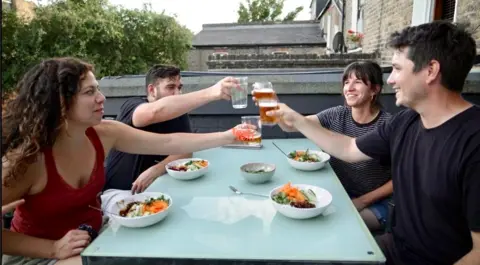
BBCFour friends keen to get on the property ladder, but finding prices too steep, clubbed together to buy a home in London. Could this be the future of home ownership?
The two couples, now each with a baby, live together in a three-bedroom flat in north-east London.
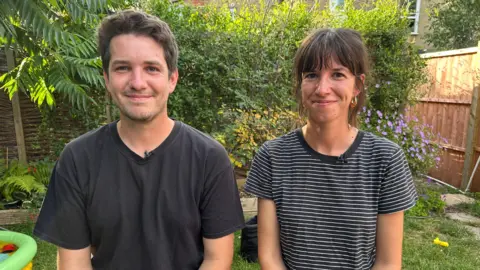
Francesca, Graeme, Sonja and Kieran, all 34, have known each other since school and university, and lived together during the Covid pandemic until the landlord "doubled the rent overnight".
From moving in, to house renovations, to the women giving birth four months apart, how is it all working out?
Francesca, a musician, says when they all bought the flat together in 2022, she and her partner Graeme would not have been able to afford a suitable place in London on their own.
Graeme says they would have been able to afford a property in the £350,000-£400,000 price range - but by bringing all four incomes together, they could afford "a lot more". They ended up paying £650,000.
He says "apart from some estate agents being surprised", there were no massive hurdles to overcome to buy as two couples versus a sole couple.
They got a floating deed of trust, a legal document that outlines how ownership of a property is divided between joint owners.
The four friends are among a growing number of people with non-traditional mortgages.
Some of the UK's biggest lenders have reported trends in people co-buying with friends, siblings and parents.
Lloyds Bank said its research found half of young first-time buyers were willing to consider more non-traditional routes to be able to afford a home, while Barclays reported "a strong interest" in non-traditional mortgages this year.
Natwest head of mortgages Lloyd Cochrane said the bank was seeing "more and more customers think about different ways of getting on the housing ladder", but there was a need to raise awareness of non-traditional ways to get there.
Sales and marketing director at Fairview New Homes, Chris Hood, said that in the past two years they had seen an increase in the number of enquiries and sales from first-time buyers teaming up with friends or family members to purchase a home.
Part of the decision for Francesca, Graeme, Sonja and Kieran was that they wanted to stay close to their workplaces in London.
It helped they were already close friends and living together "so it didn't feel like such a big step", Francesca says.
"If anything, moving in just the two of us felt like a bigger step."
Kieran points out the couples have each been together for a decade, so they were "fairly confident" they would not to split up and "cause havoc".
Francesca and Sonja found another bonus, in that they spent a lot of their maternity leave together, which Sonja says "helped in a time that can be really lonely".
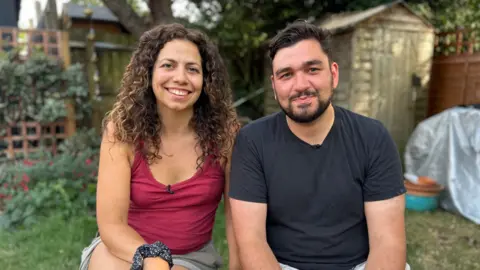
The two families share groceries, childcare and cooking - splitting all expenses four ways - and their two children get on "like siblings", according to all the parents.
The reaction from others has been positive, Kieran says.
"Whoever I tell about it, they always think it's a great idea and they like it," he says.
"But I do have to preface it with: 'It's not like a commune or anything. It's communal living.'"
SpareRoom, a UK-based website that specialises in flat-sharing and finding flatmates, recently conducted a survey on 6,524 flatmates and lodgers in the UK.
When asked how they planned to afford a deposit, of those who expected to buy a property, 89% said savings, 44% said they planned to team up with a partner, 25% said with financial help from friends or family, 17% said inheritance, 9% will team up with a sibling or parent, and 6% will team up with a friend.
Of the 14% who said they did not expect to be able to buy a property, almost half said it was because their family could not help with a deposit.
Things to consider
Adam French, consumer expert at Money Facts, said: "What happens if the mortgage cannot be paid, or for example one of you wants to move out? Having all of that crystal clear in writing is really important."
Mr French said it was important to be "really transparent" about that one bad credit score or it could bring down the mortgage application.
Insurance and stamp duty will need paying. Having a plan and an agreement in place will help to make sure things go smoothly.

Friends Mirko, 37, and Lorenzo, 30, moved from Italy to London more than 10 years ago to work in casinos.
After nine years, realising they had spent £160,000 on rent between them, they pooled their salaries and bought a two-bedroom flat in Woolwich for £450,000 with a deposit of £90,000.
"We thought... why, instead of paying rent, don't we pay a mortgage?," Mirko says. "We've known each other so long, we trust each other. We can do that."
He says the bank told them it was more likely to give a mortgage to friends because "couples are more likely to split up".
"The bond you can have with a friend is bigger than a bond you can have in a relationship," Mirko says.
Lorenzo adds that "with the money of a two-bedroom flat in London, you can buy a villa with a swimming pool" in big Italian cities like Rome and Milan, and their parents are proud of what they have achieved because they know how expensive London is.
Mirko says he would recommend the set-up for "no more than two people" because it is difficult to find friends who think in the same way, but "if you find the right person, I think it's the right solution".
It has been three years since Sonja, Kieran, Francesca and Graeme moved in together, and the experience, they say, has "really worked" - although Kieron says he would not recommend it to everyone.
"You have to be confident with who you're living with and be very open with your finances and your family plans - and have a timeline," he says.
Sonja says she could see such an arrangement working throughout different stages of life.
"I think there's something sad when your networks narrow. I see huge value for this type of investment in retirement as well," she says.
"Who knows what the next stage is for us - whether we'll continue to live together or separate into different homes - but I'd really like to have some element of communal living in my life."
Additional reporting by Anna O'Neill
Homebuyers are turning to shared ownership models.
It's morning tea time at Gem Romuld's Gwynneville home in Wollongong and there are plenty of hands to help wrangle two toddlers, clean up dishes and prepare the food.
That's because Gem lives not only with her partner Dinah Too and their two young children Thea and Marlowe, but also with her friends Lexi Dickson and Renata Field and their nine-year-old son Finnley.
This isn't a university share house — the adults purchased the property together in 2021 and have a co-living arrangement, meaning they co-own and live on the property.
Shopping and food is shared between all seven members of the household. (ABC Illawarra: Justin Hunstdale)
"We never wanted to go into a nuclear family style of living, we wanted to be with other families, with our friends," Gem said.
"Having babies that don't sleep or toddlers is really hard, and I can see how so many other parents feel isolated, but there was just no chance of that happening for us."
A glance around the home reveals a long grocery list on the fridge with details of a shared monthly shop and a chore wheel to designate household jobs.
It was a decision also made for financial reasons.
Morning tea involves plenty of hands to make food and look after children. (ABC Illawarra: Justin Huntsdale)
"We look after each other's kids, we look after each other and of course, it ultimately just meant it was possible to buy a home,"Renata said.
Cotality data shows the Wollongong subregion has the highest median house price in regional New South Wales at $1.3 million — a price that has climbed by 50 per cent in the past five years.
"We'd be in a tiny apartment or just wouldn't have been able to purchase a house at all if we were just on our own," Renata said.
The group shares shopping, cooking and chores. (ABC Illawarra: Justin Huntsdale)
With combined finances, the friends have bought and created their dream home; a main house with a granny flat separated by a vegetable garden.
A signed agreement lays out the terms for exit and a shared ethos of community and participation keeps things running smoothly.
"We're really committed to each other and to living together in a shared and equal way," Renata said.
Just a few suburbs over in Berkeley, another co-living group is preparing to share a different life stage — retirement.
Susy Lee is planning to retire to a large Berkeley home with four other couples. (ABC Illawarra: Sarah Moss)
Susy Lee and her husband Brian have joined four other couples to buy a large, rambling house on a hill, where they're currently spending weekends testing out the new living model.
"Our plan is that all 10 of us will live here full-time during retirement in the next two years," she said.
"That's what we're working towards — we're calling it a crazy experiment."
Susy Lee (second from left) says living with friends will reduce loneliness. (ABC Illawarra: Sarah Moss)
They're in the process of renovating the home to create five suites with contained bathrooms.
A household constitution sets out an agreement for divesting from the property, and Susy jokes her Masters of Peace and Conflict Studies comes in handy when negotiating big-ticket decisions.
Susy Lee says friendship and support will be a benefit of the shared home. (ABC Illawarra: Sarah Moss)
"We're doing it for a variety of reasons I suppose, but the main ones would be to combat loneliness and the financial problems of retirement," Susy said.
"Some of us have lost parents in the last year and a half and we've helped each other through that — it's been a real support."
Cohousing Australia chair Jason Hilder said collective housing models, which included co-living, co-housing — where multiple dwellings were built on a shared property — and co-ops remained unusual in Australia.
"In Australia it's less than 1 per cent," Dr Hilder said.
In some European countries it is much more common — in Sweden more than 20 per cent of housing stock is cooperative housing.
Jason Hilder says a lack of affordable housing is driving alternative living. (ABC Goulburn-Murray: Phillipe Perez)
The Australian Bureau of Statistics predicts group households — which include any living arrangement with two or more non-related and uncoupled adults — will make up 5 per cent of all households in Australia by 2046.
Dr Hilder said interest in collective models was growing due to the lack of affordable and available housing, but legislation and lending restrictions had created barriers.
"State by state, the term 'co-housing' isn't in the legislation," he said.
"There is a code for retirement villages, for boarding houses, even for social housing, but if we were to talk about co-housing or multiple families under one roof, the legislation doesn't cater for that."
NSW planning legislation defines co-living as a rental accommodation overseen by a property manager, with no mention of the shared ownership models used by the Wollongong households.
Renata Field says more co-living arrangements could help the housing crisis. (ABC Illawarra: Justin Huntsdale)
While some major banks have introduced multi-party loans to cater for shared ownership, those considering a collective arrangement still find finance difficult to secure.
Renata and Gem spent two years trying to find a suitable lender, and the Berkeley couples had to set up a business collective to borrow the money they needed.
Property share is a flexible and practical option for anyone looking to split the cost of a home while maintaining financial independence.
Renata said more people should think outside the box when it came to housing.
"I think this great Australian dream of having a house with two-and-a-half kids on a quarter-acre block, it just can't work for everyone,"she said.
"There's not enough resources and there's not enough housing.
"This is not for everyone, but I would encourage people to have conversations with people they love about whether they could imagine it."
Paul Ewart, Journalist
First published 12 Jul 2024, 3:40pm
As we’re all very much aware, getting on the first rung of the Australian property ladder these days is tough.
For those not already in the market, saving for a deposit feels increasingly out of reach as rising home prices and rents, paired with higher interest rates and living costs.
In June, national home prices hit new record highs – up more than 6.5% over the past year, according to the latest PropTrack Home Price Index.
Meanwhile, the number of first-home buyer new loan commitments fell 3.3% in May, and were only marginally higher compared to a year ago, increasing 3.7% nationally, according to the Australian Bureau of Statistics.
This means that fewer and fewer first-time buyers are able to enter the market and those that do are having to take on crippling mortgages to achieve it.
But while the dream of owning bricks and mortar is becoming more elusive, there is another option for wannabe homeowners looking to get their foot on the first rung of the property ladder: buying with friends.
“Buying with friends remains uncommon but has seen more interest with the continued increase in home prices,” said PropTrack senior economist, Paul Ryan.

Many young Aussies are weighing up buying a home together to get onto the property ladder. Picture: Getty
“Reflecting this, the Home Guarantee Scheme now allows joint purchases — with as little as a 5% deposit — without requiring the purchaser to pay for lenders mortgage insurance.”
Last year, the government amended what was formerly known as the First Home Loan Deposit Scheme (which previously only covered singles and married or de facto couples) into the new model that allows friends to buy together.
“The scheme allows 35,000 applicants annually,” explained agent and chief communications officer at First National Real Estate, Stewart Bunn.
“You must be at least 18 years of age, earning no more than $125,000 (individuals) or $200,000 collectively for friends applying together. It’s a fantastic initiative that really helps friends get into the market sooner rather than later, without the financial impediment of mortgage insurance, which protects banks, not individuals.”
While the benefits of pooling your financial resources to significantly increase your purchasing and borrowing power is obvious, co-owning with friends doesn’t come without potential pitfalls.

PropTrack senior economist Paul Ryan says buying a property with friends is gaining more and more interest as home prices continue to rise. Picture: Supplied
Indeed, there’s a multitude of considerations before you commit to committing to a property purchase with your buddies.
Here's the latest expert advice on the buying-with-friends dos and don’ts before you make the leap.
It’s an age-old adage that too many cooks spoil the broth. Well, when it comes to buying with friends, that maxim is doubly true. In order to keep the purchase as trouble free as possible, it’s important to limit the number of co-owners to reduce complications and complexities.
“Without doubt, less is more when it comes to buying with friends,” said Mr Bunn. “It’s critical to draw up a co-ownership agreement and the fewer parties involved, the greater chance of success.”
Just as with any personal or business relationship, compatibility is key. Though you might be BFFs when you sign on the dotted line, when the proverbial hits the fan a few years down the track, this may not be the case.
Financial woes are often one of the biggest contributors to marital breakdowns and the same principles apply when it comes to friends in a co-ownership arrangement. Watch out for any early warning signs or red flags and make sure you have no doubts before taking this financial leap.

Finding potential co-owners who share similar financial goals and lifestyles is key. Picture: Getty
“It is crucial to partner with friends who are not just trustworthy, but also share similar financial goals and lifestyles,” cautioned mortgage broker at Eden Emerald Mortgages, Shaun Bettman.
“Look for those you can trust and who share your views and passions about property (if you’re investing), or that you could live with if the plan is to become an owner-occupier. Always look to protect friendships and relationships and ensure that all parties have similar expectations about property management and investment returns to prevent future conflicts.”
Given the potential hazards involved when buying together it’s vital that everybody remains clear-eyed about the scope of the undertaking.
Any property purchase is a big financial commitment, not only because of the decades of monthly repayments, but also the responsibility for ongoing expenses involved in running and maintaining the property.
As such, being upfront about your individual finances from the get-go is highly important before you even begin your real estate search.
“Friends should spend some time going over their finances, being as honest and open as possible about each person’s expenses, spending, savings and debts,” said Mr Bunn.

It's important to be open about your finances before buying a home together. Picture: Getty
“This gives a true picture of each person’s financial strengths and weaknesses.
“Drawing up individual budgets is a good exercise to learn exactly where your money goes. Knowing each other for what seems like forever does not mean you have any idea about what each of you does with your money.
“Discuss what your current budgets are and how they will have to change to manage the new expenses. It’s important you both understand the commitments of buying a house with a friend.”
The fundamentals of a wise property purchase and borrowing are the same whether you are buying alone or with others. You need to consider your financial position now — including whether you can afford the deposit, ongoing expenses and any unexpected costs — as well as in the future.
“Ensure the property is affordable for the group and that borrowing levels are sustainable, even if someone's personal circumstances change,” said Mr Bettman.“Take into account planned changes such as someone starting a family, changing to part-time work or anything that can affect the amount of money an individual earns.”
Before you and your co-owners begin your search it’s also important that you have a shared vision - one that’s realistic - for your property purchase and that you stick to the search parameters.
All parties should agree on key property criteria such as location, type of property, and potential for growth. Consensus on these points can ensure that the property meets everyone's needs and expectations.

Co-owners should agree on key property criteria like location and type of property. Picture: Getty
“As always, the fundamentals of property wisdom apply,” said Mr Bunn.
“Location, location, location, or you buy the worst house in the best street. Properties with a good outlook or aspect, near transport or education infrastructure, shopping centres or the like are always likely to perform well over the longer-term.”

Whilst you likely have a long history with your friends, when it comes to any financial commitment with them you need to think with your head and not your heart.
“Once you’ve decided that you can buy a house together it’s important to plan ahead and have a clear understanding of what you want and what your individual responsibilities will be,” said Mr Bunn.

Decide early who will be responsible for activities such as gardening and maintenance issues. Picture: Andrew Zaeh
“If one of your longer-term goals is to be in a relationship and start a family, then it’s safe to assume that will happen during the course of your mortgage.
“You’ll also need to consider who is responsible for what a property needs to be regularly maintained. Decide prior to buying who will be in charge of calling tradespeople, who will take care of the garden and who will go to the body corporate meetings — all of these responsibilities need to be considered and allocated in advance to avoid confusions and resentment in the future.”
Whilst buying with friends has its clear advantages — especially given the affordability pressures we are witnessing — there are also a number of associated risks with it too.
What happens if one co-owner can’t afford their share of the mortgage payments? What happened if one of you wants to sell and the others don’t? These can be serious issues that could put you in a great deal of difficulty, both personally and financially.

Financial advice is recommended for anyone considering purchasing a property with friends. Picture: Getty
“While a joint purchase may seem like a short-cut into the housing market, buyers need to think about the complexities it can introduce,” cautioned Mr Ryan.
“People considering purchasing with friends should definitely get financial advice for their particular circumstance, as these arrangements can introduce complex issues, particularly if one of the purchasers wants to sell or can no longer pay their share of the mortgage.”
Before committing a huge chunk of your finances it’s necessary to both do your legal homework and to make sure that there are legally binding agreements in place to protect the interests of all parties.
A formal agreement is a great way to put issues on the table, identify problems you may not have considered, and to map out the way forward if things go bad.

A formal agreement will protect the interests of all parties. Picture: Getty
“A co-ownership agreement should clearly detail what happens if your friends can’t pay the mortgage, wants to sell their share in the property, if the relationship deteriorates, or there is a death,” explained Mr Bunn.
“You may need to set up a joint bank account for expenses, outsourcing maintenance and putting direct debits in place for mortgage and bill payments.”
While you’ll go into this with the best of intentions — and the best hopes — sometimes things don’t go to plan. Because of this grim reality it’s important to have an exit strategy in place if, for example, a friend wants to sell their share or if you decide to part ways.
“While no one wants to think about this, we all need to be prepared for the worst,” said Mr Bettman.
“Be prepared for scenarios where co-owners may default on payments, wish to sell early, or other unforeseen circumstances arise, such as loss of income. Having an agreed-upon exit strategy can alleviate potential legal battles or financial losses, ensuring all parties understand the available options if the co-ownership needs to be dissolved.
“While buying with friends can make property ownership more accessible to Australians, it comes with its own set of challenges that require careful planning and consideration. By setting clear rules and maintaining open communication, co-buyers can manage their property effectively and enjoy the benefits of their investment.”
With the help of a lawyer, Emily and Kate realised their dreams of home ownership together as friends. (Supplied)
After almost a decade of friendship, Emily and Kate have been through a lot together.
Now they can add property ownership to that list.
After separating from her husband, Emily — a community arts teacher — was unsure whether her future would include stable housing.
"It was the financial crisis instigated by my marriage breakdown that forced me to think about how I was going to create financial security for myself in the second half of my life, which I feel is a common question for women after divorce," the 44-year-old says.
"As I've worked in community arts for most of my life, I'd often felt that owning property would be out of reach financially, so I'd already been considering alternative property options."
Those thoughts were shared by Kate, 42, who had contemplated what home ownership might look like outside of a heteronormative relationship.
"My friends and I had dreamed for many years of this feminist notion of creating a Spin (Spinster) City," she says.
"While I've had the privilege of a middle-class upbringing, I didn't have the benefit of that financial support from parents."
When Kate and Emily realised they were working towards the same goal, the pair started discussing how they could make joint-property ownership work for them.
"Kate and I entered into this arrangement with an enthusiastic respect for each other's boundaries," Emily says.
"We both knew we wanted to live in the Blue Mountains so we started to look for properties that had two dwellings, so that we could live independent lives that were financially viable for both of us."
Together they created a wish list. Kate's additions to the list included a garden with plenty of sun and a water tank, and somewhere that was close to nature and a train station.
Emily's top considerations were a bath, good heating, storage space for her van and drums, and a yard for her dogs Barry and Petunia.
In early 2021, the pair found a property that ticked almost every box on their list. They then met with a lawyer to sort out a contract they were both happy with.
In May, they moved into the property, which is on almost a quarter-acre and features a three-bedroom house (Emily's home, affectionately known as The Chateau) and a two-bedroom granny flat (Kate's home, affectionately known as The Folly).
Emily and Kate in their yard with Emily's dogs, Barry and Petunia. (Supplied)
Kate and Emily are tenants in common and equal stakeholders in the property.
The way the property is divided perfectly suits both of their passions. Emily loves a good bath (The Chateau has a bath and The Folly doesn't) while Kate enjoys gardening.
"With the property we have purchased, I am able to plant native species and to hopefully grow enough food to feed the two of us," Kate says.
Emily adds: "I think Kate is very respectful of the fact this is Dharug and Gundungurra land, and her priority has been to treat the land with respect."
Six months after purchasing the property, Kate and Emily couldn't be happier with their decision.
"It's pure bliss, I can't imagine a situation that would suit me better," Kate says.
"It is the best of both worlds, you can have your boundaries, but also enjoy that companionship when you want it."
Emily couldn't agree more.
"Especially during lockdown, it's been wonderful to have a friend who you can message and be like, 'cocktails and craft tonight?'" she says.
Emily and Kate say their arrangement is the "best of both worlds". (Supplied)
As for how the pair manage conflict, they say it all comes back to having that solid foundation of honest communication.
"Even with the difficult conversations we've been able to come to a conclusion around them pretty quickly," Kate says.
"I think as mature people in our 40s there is a sense that you know yourself quite well and that comes in very useful when you're negotiating with someone else."
Though their experience has been positive, they did encounter some naysayers at the beginning of their journey.
"I had so many people say to me, 'Do you think that's a good idea mixing friendship and money?'" Emily says.
"The reason that was so stark to me was that I didn't have anybody say that to me when I bought a property with my ex-husband.
"It's that heteronormative narrative of meeting, falling in love, buying a home, having kids and living happily ever after. If that works for you, that's great, but life doesn't unfold that way for everybody.
"We're not as familiar with the idea of two friends saying to one another, 'I can't do this on my own, but if we work together, we could totally do this'."
Kate agrees that it was an opportunity to think beyond the standard narrative.
"Like many queer people, my journey towards home ownership hasn't been as straightforward as that of many heteronormative people," she says.
"You do need a relationship where you are very comfortable talking about your boundaries … that's essential," Kate says.
Emily agrees and adds that those boundaries can then be confirmed through the legal process.
"It's important to have a contract written up so you're both protected," she says.
"We found that the lawyer was also able to point out things that we hadn't thought of. They have seen things go wrong and can advise you of the common pitfalls."
Bunkered down in their new home during lockdown, the pair are feeling optimistic about non-traditional home ownership as an option for women who are struggling to get into the property market.
"There's more than one way to create a beautiful human life," Emily says.
"I believe it's possible to take the challenges we face as reasons to band together and help one another move forward in positive ways."
Kate agrees: "To me it feels like the most extraordinary gift we could give to each other."
Kate Reid is a freelance writer based in the Blue Mountains. Her work has been published by ABC Everyday, The Sydney Morning Herald, Broadsheet Sydney and We Are Explorers.
I am 34 years old and was born in southern Bhutan. My family were part of the Nepali-speaking Bhutanese community, known as Lhotshampas. My father was a businessman and we had a farm.
Perceiving the Nepalese culture and language as a threat to the unity of Bhutan, in the 1980s the government decreed that all citizens wear Bhutan national dress and speak the national language. My father took part in demonstrations against the new laws and advocated for human rights and democracy. Often the army came to our house to try to arrest him, so he left the country. One night seven months later, in 1991, my mother, grandfather, sisters, brother and I walked across the border to India. I was nine.
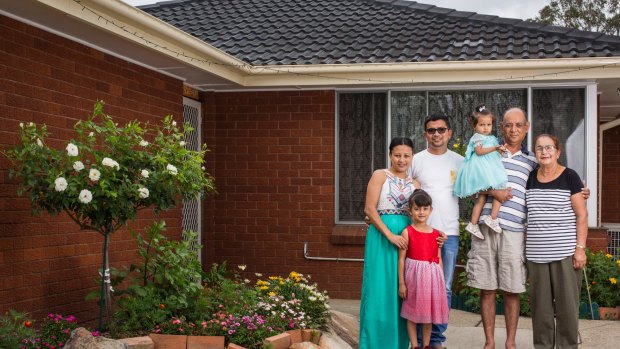
Three generations of the Chhetri family in their home in Marayong in Sydney, with the five adults paying the mortgage. From left are Goma Khadka Chhetri, Sharon Chhetri (older daughter), Suman Chhetri, Shayana Chhetri (younger daughter), Nakul Chhetri and Dibyasori Chhetri.Credit:Dominic Lorrimer
I spent 19 years in a refugee camp in Nepal. Initially there wasn't enough food, we walked 20 minutes to get water from the river, and everyday people were dying of malaria, cholera or typhoid. More than 100,000 Lhotshampas left Bhutan in the 1990s, and most went to refugee camps in Nepal.
The resettlement process started in 2008. My wife, Goma, and I came with my sister to Australia in 2010. My parents, brother and grandfather, who died a year after he arrived, joined us six months later.
We were brought from Sydney Airport to a serviced apartment in Blacktown. It had a washing machine, a microwave and a toaster, but we didn't know how to use them. There were some vegetables in the fridge, and western food we'd never seen before. We didn't open a tin of sardines for two weeks, because we had no idea what was inside it. A settlement organisation helped us set up bank accounts and register with Centrelink and Medicare. The other Bhutanese families already settled in Sydney assisted us. A boy I taught in the camp stayed with us for several days and helped me buy a mobile phone.
Then we moved into a unit. The rent was $800 a fortnight, including water and electricity. We each received $424 from Centrelink a fortnight, so between three of us we had $472 to live on. It was hard to manage because of the cost of living. We walked rather than taking public transport, so we could save $1.50.
I began doing programs with STARTTS, a service for trauma survivors and refugees. Then I facilitated programs for newly arrived refugees.
In 2012, I started working 15 hours a week, earning $15 an hour, as a cleaner, while I studied civil construction at TAFE. As a refugee, I had acquired a Bachelor of Science, but I didn't know the pathways to work were so different here. When I completed my advanced diploma in civil construction I couldn't get a job, because everyone asked for local experience. So, I started an engineering degree, but then heard it was hard to get an engineering job, so switched course, and did a three-year nursing degree at the University of Western Sydney.
In 2013, Goma began working as a childcare educator and I started working for Western Sydney Local Health as a community mental health nurse in 2016. My brother had found work soon after he arrived. We were paying $475 a week for a four-bedroom house, and now we thought about buying our own place.
We bought our four-bedroom house in January 2017. The house was more than $700,000. My wife and my savings were pooled with my brother's to put down a 10 per cent deposit. Goma and I live here with our two children, aged 6 and 2, my parents and brother. The mortgage is more than $3000 a month, but three of us work, and my parents get a pension, so also contribute.
We don't spend much on takeaway food and we cook and eat at home. We go out once or maybe twice a month. When we take the children out we try to do things that don't cost much money.
My parents lost everything in Bhutan, and it makes them proud to have a house. We are happy and have a sense of belonging here.
Tenancy in common – similar to joint tenancy – is a means of co-ownership of a commercial or residential property. What’s the difference between the two?
Joint tenancy, as described by the ATO is where “joint tenants have an equal share in the ownership of an asset. If a joint tenant dies, the other tenant (or tenants) has a right of survivorship. The deceased tenant's interest is not an asset of their estate.”
On the other hand, tenancy in common is defined as “two or more people who separately own a percentage of a property. The percentages may be unequal. Tenants in common can bequeath their share of the property to anyone.”
A major difference between the two is when someone dies in a joint tenancy, “the deceased’s interest is taken to pass in equal shares to the surviving joint tenants, as if the interest is an asset of the deceased estate and the surviving joint tenants are beneficiaries.”
Conversely, with tenancy in common, the shares of the property become part of the deceased estate, as there is no right of survivorship. The portion of property can therefore be transferred to a beneficiary of the estate or sold by the legal personal representative of the estate.
However, another major difference is that tenants in common can sell their share of the property without the agreement of the other tenants. Joint tenants require the compliance of the other joint tenants.
While this can be beneficial for those looking to enter the housing market on a budget, there are risks involved, such as each co-owner being liable for the debts of the other owners.
Where tenancy in common can become a benefit is for people looking to downsize without having to move.
“There are thousands of affordable homes hiding in plain sight. Mum and dad, empty nesters that have got the four- or five-bedroom house that want to downsize, they don’t have to move from their neighborhood and their family home necessarily. They can do a renovation and create a separate living space and move back into a smaller, two bedrooms and living area,” said ticX managing director Tony Puls.
“They can sell 40 per cent or 50 per cent of the property to someone as a tenant in common. They both then become tenants in common. The person who’s bought the 40 per cent or 50 per cent has rights of occupancy or can rent it out to somebody else for that particular part of the property.”
Puls believes tenancy in common is “Australia’s best kept secret”, as not enough people aren’t taking advantage of it.
“Fewer and fewer people are able to take out a large mortgage to buy a property on their own. Shared ownership comes into play eventually as things get just out of reach and too expensive … It’s Australia’s best kept secret,” said Puls.
“People don’t know what tenancy in common is. They think it’s something to do with renting, not ownership. So, there’s a lot of education to do.”
According to Puls, mortgage brokers are missing a real opportunity to expand offerings. He believes many are unaware of this method.
“We’re trying to encourage brokers and make lenders realise that there’s this huge untapped market. And if they just understand the law and know as a fact, as an absolute fact, that a tenant in common share can be mortgaged,” Puls said.
“What we want to try and encourage lenders to do is to create and develop lending products that address the need of individual tenants in common to mortgage their share only, not the whole property.”
This type of ownership covers both commercial and residential mortgages.
“It can be anything. It can be rural or commercial. When you look at the types of properties, you’ve even got resort style property like condominiums, or high-rise apartments on the Gold Coast, holiday properties,” said Puls.
“Somebody in Melbourne, where it’s cold, could own 25 per cent of an apartment on the Gold Coast. And that’s probably enough for the family use. And it’s an asset they own that they will appreciate over time.”